
In DTF garment printing, transfer film is often treated as a low-cost consumable rather than a functional component. This misconception is one of the primary reasons for unstable adhesion, inconsistent peeling behavior, and premature wash failure in production.
DTF transfer film is not merely a PET sheet used to carry ink. It is a coated release system that controls ink anchoring, powder fusion, thermal transfer, and release timing. Its performance directly determines whether the printed image can be transferred to fabric as a complete, durable layer.
DTF transfer film is a functional carrier film designed to temporarily hold ink and adhesive powder during printing and curing, and then release the image onto textile substrates under controlled heat and pressure. For buyers evaluating real production parameters, detailed construction and usage information can be reviewed here:
👉 DTF Transfer Film product specifications
This article explains how DTF transfer film works in garment printing, how it is classified, and how structural differences influence production stability.
What Is DTF Transfer Film?
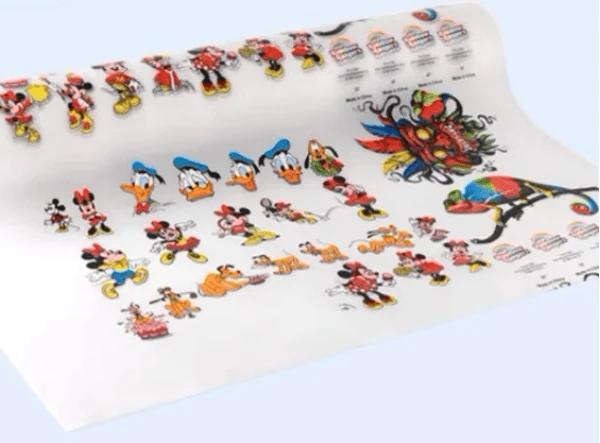
DTF transfer film1 is a coated polymer film engineered specifically for the DTF printing process. While PET is commonly used as the base material, the performance of the film is determined primarily by its surface coating2 rather than the base film itself.
The coating performs two conflicting functions: it must provide sufficient surface energy to anchor ink droplets during printing and curing, while also allowing controlled release of the cured ink and adhesive layer during heat transfer.
This balance between adhesion and release is highly sensitive. Films that hold ink too weakly cause image deformation during curing, while films that release too aggressively often lead to incomplete transfer or edge lifting. From a process standpoint, DTF transfer film acts as a temporary substrate that defines image integrity until the final bonding step.
How Does DTF Transfer Film Work in the Garment Printing Process?
In the DTF workflow, transfer film determines stability at every critical stage.
During inkjet printing, the coated surface controls dot gain and ink wetting behavior. An unstable coating leads to bleeding, poor edge definition, or inconsistent ink thickness.
After printing, adhesive powder is applied to the wet ink layer. The film coating must resist powder migration while allowing uniform powder attachment. Any surface inconsistency directly affects bonding strength.
During curing, thermal exposure partially melts the powder and integrates it with the ink layer. At this stage, dimensional stability of the film becomes critical. Film shrinkage or warping introduces internal stress into the transfer layer.
Finally, during heat pressing, the film must release the entire ink–powder structure cleanly and consistently. Release timing—whether hot, cold, or instant peel—is governed by the coating formulation rather than the PET base.
Structural Classification of DTF Transfer Film: Single-Sided vs Double-Sided
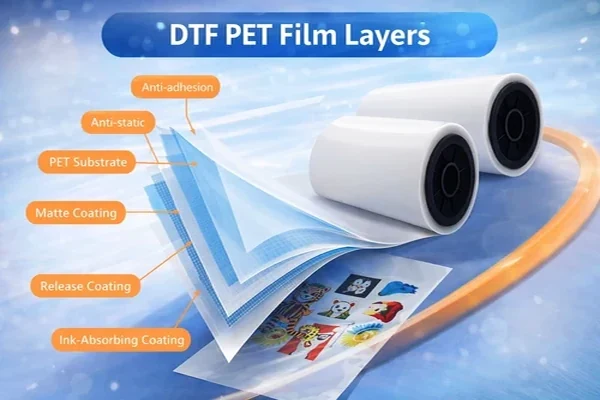
Beyond peel behavior, DTF transfer films can also be structurally classified based on coating configuration, which directly affects production stability.
Single-Sided DTF Transfer Film
Single-sided DTF film features a functional coating only on the printing side, with the reverse side remaining untreated PET.
This structure is widely used due to lower cost and simpler handling. However, during high-speed printing or powder application, the untreated backside can generate static electricity, leading to powder contamination or feeding instability.
Single-sided films are generally suitable for low to medium production volumes and controlled environments.
Double-Sided DTF Transfer Film
Double-sided DTF film includes a functional coating on the printing side and an anti-static or treated layer on the reverse side.
The backside treatment reduces static buildup, improves film feeding accuracy, and minimizes powder adhesion to non-print areas. This structure significantly improves consistency in automated or high-volume production.
Factories focused on repeatability and defect reduction often reference
👉 DTF Transfer Film product specifications
when selecting double-sided configurations to stabilize their workflow.
What Types of DTF Transfer Film Are Commonly Used?
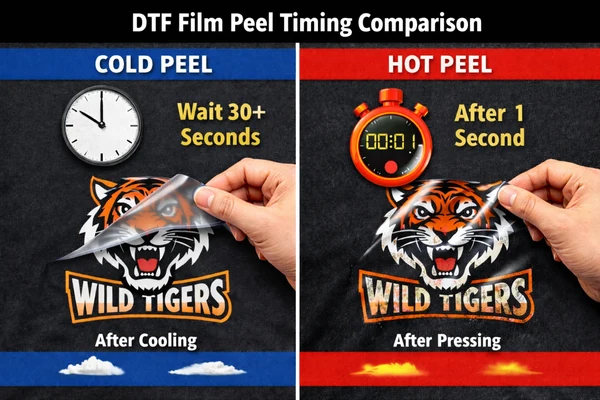
DTF transfer films are commonly categorized by peel behavior, which is determined by coating chemistry rather than film thickness.
Cold peel films1 require full cooling before peeling and generally provide stronger adhesion and higher wash durability.
Hot peel films2 allow immediate peeling after pressing and are favored in fast-paced production environments.
Instant peel films balance speed and control, allowing peeling after brief cooling and reducing waiting time between presses.
Peel type selection should be aligned with workflow rhythm, fabric type, and acceptable error tolerance.
How Does DTF Transfer Film Affect Print Quality and Durability?
DTF transfer film directly influences adhesion strength, edge sharpness, and wash resistance.
Many durability issues attributed to ink or adhesive powder originate from coating incompatibility. Inconsistent release behavior can create micro-delamination that only becomes visible after repeated washing.
From a quality control perspective, transfer film is one of the most sensitive variables in the DTF system. Buyers comparing options should evaluate coating stability rather than focusing solely on price or appearance. Technical parameters and application guidance are outlined in
👉 DTF Transfer Film product specifications.
How to Choose the Right DTF Transfer Film for Your Production?
Selecting the right DTF transfer film should begin with production conditions rather than generic recommendations.
High-volume or export-oriented factories benefit from double-sided films with stable release behavior. Small customization businesses may choose single-sided films if environmental control is adequate.
Peel type should match production speed and operator experience. Mixing different film structures or peel types without process adjustment significantly increases defect rates.
In practice, film selection is a process optimization decision, not a consumable cost decision.
Conclusion
DTF transfer film is not a passive carrier but an active control layer that governs the success of garment printing.
Understanding coating behavior, structural differences such as single-sided versus double-sided films, and peel characteristics allows manufacturers to reduce variability and improve long-term reliability.
In DTF printing, stable production starts with the right film choice.