
I learned very early that choosing the wrong DTF transfer film can ruin even the best printer setup. Colors fade, powder scatters, and peeling becomes unpredictable. These mistakes cost time, money, and customer trust.
The best DTF transfer film is determined by coating quality, peel type, anti-static performance, and fabric compatibility—not by price alone.
%(一定要是百分比键,而不是感叹号)[best dtf transfer film](https://placehold.co/600x400 “best DTF transfer film”)
After years of hands-on production, I now treat DTF film as a core production material, not a basic consumable. The right film stabilizes output, reduces failure rates, and protects long-term profitability.
What Is a DTF Transfer Film?
Many beginners underestimate how important the film really is.
DTF transfer film is a specially coated PET film designed to receive ink, hold adhesive powder, and release the printed design cleanly onto fabric during heat pressing.
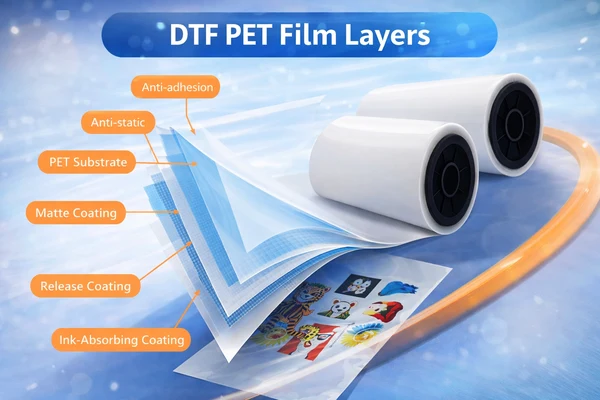
A professional DTF transfer film1 is made of multiple functional layers. These include a PET base, an ink-receiving coating, a release layer, and often an anti-static back coating. Each layer directly affects printing stability2.
If the coating absorbs ink unevenly, white ink becomes patchy and colors lose brightness. If the release layer is unstable, peeling fails or damages the print. Poor film quality also leads to oil return, rough edges, and powder contamination. In real production, most DTF problems are film-related rather than printer-related. That is why choosing the best DTF film is one of the most critical decisions in DTF printing.
Hot Peel vs Cold Peel DTF Film: Which Is Better?
This is one of the most searched DTF questions, and for good reason.
Hot peel vs cold peel DTF film differs in peeling timing, release coating type, detail performance, and production speed.
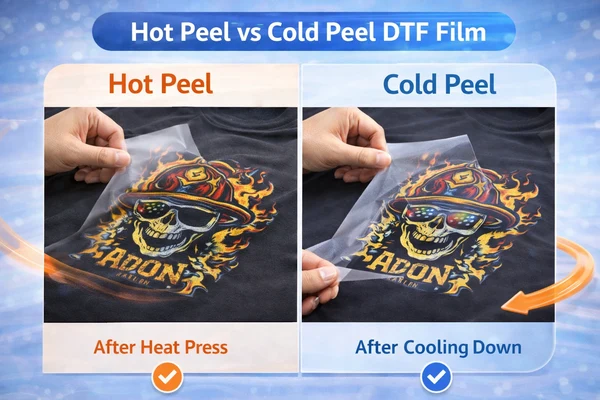
Hot peel DTF film1 allows peeling immediately after heat pressing. It usually uses wax-based release coatings. This type of film improves speed and is suitable for bold designs, logos, and high-output environments. However, hot peel films are less forgiving for fine lines and small text.
Cold peel DTF film2 requires the transfer to cool before peeling. It commonly uses silicone-based release coatings, which provide smoother release and better control. In my experience, cold peel DTF film delivers more consistent results for detailed artwork and mixed fabric orders.
If your priority is speed and simple graphics, hot peel works well. If your priority is quality, detail, and stability across fabrics, cold peel is often the safer and more professional choice.
Why Double Sided DTF Film Is Better for Production Stability
Many DTF failures start from static issues that people ignore.
Double sided DTF film includes an anti-static matte coating on the back, improving powder control, feeding accuracy, and overall print stability.
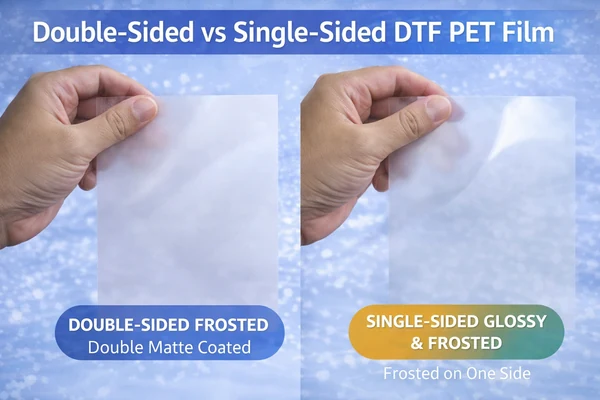
Single-sided DTF film only focuses on ink reception. In dry or hot environments, static electricity builds up on the film back, attracting adhesive powder and causing dirty edges.
Double sided DTF film solves this problem by adding a matte anti-static coating1 on the back side. This reduces powder scattering, improves film feeding, and protects printer components. In real factory conditions, double sided DTF film2 significantly lowers reprint rates and operator frustration.
For professional workshops and factories, double sided matte DTF film is not optional. It is a key factor in maintaining consistent output and reducing downtime.
How Coating Quality Determines the Best DTF Film
This is where premium and low-cost films truly separate.
The coating formula of a DTF transfer film determines ink absorption, color density, edge sharpness, and peel consistency.
%(一定要是百分比键,而不是感叹号)[dtf film coating quality](https://placehold.co/600x400 “DTF film coating quality”)
High-quality coatings balance absorption and control. Ink spreads evenly without bleeding. White ink layers stay smooth and opaque. Adhesive powder bonds cleanly without over-adhesion.
Low-quality coatings absorb ink unevenly or too slowly. This causes oil return, dull colors, and rough textures after pressing. Over time, poor coating quality also increases nozzle clogging and powder waste.
From my experience, stable coating quality saves far more money than cheap film pricing ever can. Consistency is what defines the best DTF transfer film1 for long-term production.
Matching DTF Film to Fabric and Application
The best film always depends on how the final product is used.
DTF film selection should match fabric type, stretch level, washing frequency, and end-use conditions.
%(一定要是百分比键,而不是感叹号)[dtf film fabric compatibility](https://placehold.co/600x400 “DTF film fabric compatibility”)
For elastic sportswear, the film must release smoothly and maintain flexibility. For cotton and heavy garments, adhesion strength1 matters more. For sublimation fabrics, anti-migration film2 and black powder are required.
Ignoring fabric compatibility leads to cracking, color migration, and customer complaints. Before choosing a film, I always define the fabric, washing conditions, and durability expectations. The best DTF film supports the product, not limits it.
Why I Choose YXCDTF as My DTF Film Supplier
As a supplier, I understand production reality.
The best DTF film supplier focuses on stability, not shortcuts or low pricing.
%(一定要是百分比键,而不是感叹号)[yxcdtf dtf film factory](https://placehold.co/600x400 “YXCDTF DTF film factory”)
At YXCDTF, we design double sided matte DTF films1 with stable ink absorption2, strong anti-static performance, and predictable peeling behavior. Our films are tested under real production environments, not only lab conditions.
Our integrated supply chain allows strict control of PET quality, coating formulation, and batch consistency. This helps our B2B customers reduce downtime, lower failure rates, and maintain stable output even in humid or hot climates.
For production managers, reliability equals profit. That is why film selection should be treated as a strategic investment.
Conclusion
The best DTF transfer film is the one that matches your production environment, fabric requirements, and quality standards. Choose stability over price, and your DTF results will improve consistently.